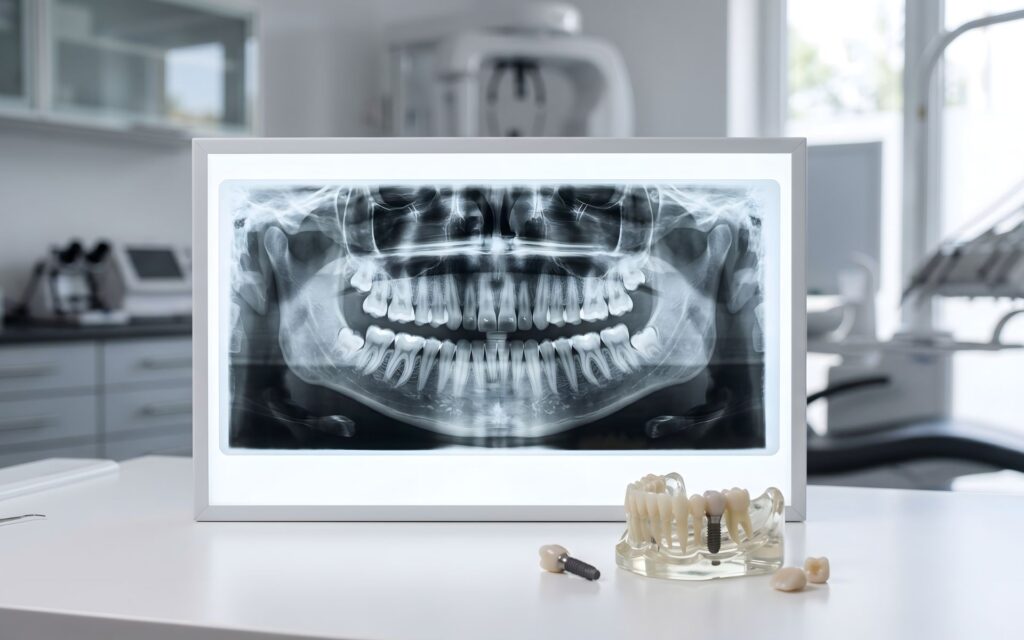


When the upper jawbone is too little or too thin, receiving a traditional implant can seem impossible. Zygomatic dental implants were created for exactly this: they offer a safe path even when there is not enough bone, without giving up fixed and stable teeth.
If you have been told that you do not have enough bone for implants, this technique can change your outlook. Let’s see what it is, how it works, and when it represents the right choice.
What are zygomatic implants and why they make a difference
A classic dental implant is inserted into the alveolar bone, the portion that surrounds the roots of the teeth. Zygomatic implants, on the other hand, are longer and find anchorage in the zygomatic bone, the sturdy cheekbone that forms the upper part of the cheek.
This bone is dense, compact, and rarely subject to resorption. By anchoring to such a solid base, the implant bypasses the area where bone is missing and immediately achieves high stability, even where a traditional implant would not find support.
When bone is not enough: the problem of maxillary atrophy
The lack of bone in the upper jaw is more common than you might think. The main causes are:
- tooth loss, which starts a progressive resorption of the unused bone;
- prolonged edentulism, which increasingly thins the bone crest;
- advanced periodontitis or previous failed implants;
- expansion of the maxillary sinus, which reduces the available bone space in the posterior area.
In these cases, the traditional path involves bone grafts or maxillary sinus lifts: valid procedures, but they extend timelines, increase costs, and are not always feasible. Zygomatic implants offer an alternative that avoids most of these procedures.
How the surgery takes place and the advantage of immediate loading
Everything starts with accurate planning, which is increasingly precise today thanks to digital technology.
Digital planning and precision
Through CT scans and computer-aided design, the specialist studies the exact position of each implant, the ideal trajectory, and the angle in advance. This reduces unexpected issues and makes the surgery safer and more controlled.
Fixed teeth in less time
In many cases, two zygomatic implants are used, often combined with traditional implants in the frontal area; in situations of more severe atrophy, four zygomatic implants can be used.
The stability achieved frequently allows for immediate loading: within a few hours or days, it is possible to apply a temporary fixed prosthesis and leave the clinic with fixed teeth on implants.
Who zygomatic implants are suitable for
This technique is not for everyone, but it often represents the best answer for those in specific conditions. It is especially indicated for:
- those with severe atrophy of the upper jaw;
- those who do not have sufficient bone for traditional implants;
- those who want to avoid long and complex bone grafts;
- those who have already faced failed grafts;
- those who want fixed teeth on the upper arch in a short time.
Preliminary evaluation remains fundamental: only a thorough clinical analysis, together with an expert team, can determine if zygomatic implants are truly the most suitable solution for your case.
Why choose Resta in Italia for zygomatic implants
Zygomatic implants require great surgical experience and advanced planning tools. It is not a procedure to improvise on or to save on at all costs.
Choosing to stay in Italy means relying on a specialized team that follows you before, during, and after the surgery, with traceable materials and scheduled check-ups over time. The peace of mind of knowing who is responsible, and where, is worth more than any promise of savings.
Do you want to know if zygomatic implants are the right solution for your case?