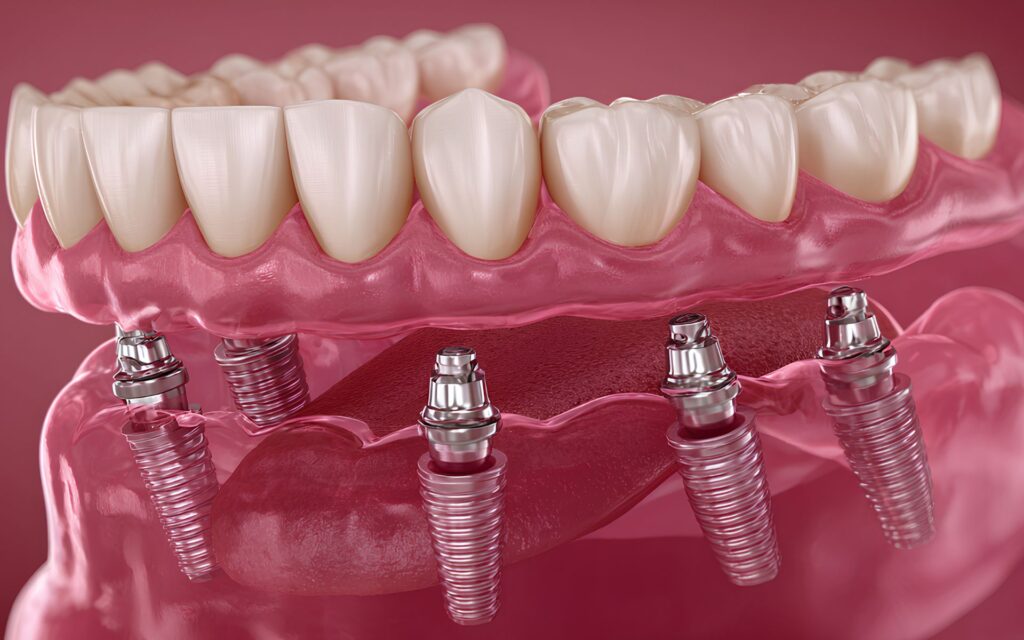


The Toronto bridge is a fixed restoration that replaces an entire arch by resting on four or six dental implants. It is screwed onto the implant structure and cannot be removed by the patient, only by the professional during checkups.
It takes its name from the protocol developed at the Canadian university where it was perfected and is recognized by one specific element: a rigid metal bar that supports the prosthetic teeth and distributes chewing forces across all implants.
How a Toronto Bridge Is Made
The base structure is a titanium or alloy framework, custom-made after taking impressions. The prosthetic teeth are mounted on this framework, in resin, composite, or ceramic depending on the agreed treatment plan.
The assembly is then screwed directly onto the implants. The access holes to the screws remain closed with an aesthetic material and can be reopened in the office whenever the prosthesis needs to be unscrewed for thorough maintenance.
The rigidity of the framework is the characteristic that makes this solution suitable even for complete arches: it connects all implants into a single unit and reduces concentrated loads on any single point.
What Benefits Does the Toronto Bridge Offer
Compared to a removable denture, the Toronto bridge has effects primarily in daily life.
Specifically, it guarantees:
- constant stability, with no movement during chewing or conversation
- no use of adhesive pastes
- free palate in most upper restorations
- uniform load distribution thanks to the rigid structure
- ability to unscrew the prosthesis in the office for targeted checkups and maintenance
- repairability of individual elements without redoing the entire restoration
It must be said with equal clarity that a fixed structure requires more careful daily cleaning, because the space under the prosthesis must be reached every day with dedicated tools.
Toronto Bridge, All-on-4, and Bar-Retained Prosthesis: How to Navigate
The terms are often used as synonyms, but they indicate different things. All-on-4 and All-on-6 describe the number and angulation of the implants, that is, the surgical protocol. Toronto instead describes the type of prosthesis that is screwed on top.
An All-on-4 restoration or All-on-6 can therefore be completed precisely with a Toronto bridge. The real comparison is not between these acronyms, but between fixed and removable solutions.
The bar-retained overdenture, on the other hand, remains anchored to the implants but can be removed by the patient for cleaning. It’s a different choice, one that favors ease of hygiene over the sensation of fixed dentition.
Who Is the Toronto Bridge Suitable For
The evaluation always starts from clinical conditions, but there are profiles in which this solution is considered more often.
- those with a toothless arch or with elements that can no longer be saved
- those who want a solution that is not removable and does not require adhesives
- those who have sufficient bone or can access regeneration techniques
- those willing to maintain a careful home hygiene routine
- those who can regularly attend scheduled checkups
Some general conditions, smoking, or untreated periodontitis require a preparatory process. We discuss this in detail in the article dedicated to contraindications to dental implants.
Hygiene and Maintenance of a Toronto Bridge
Daily cleaning must focus on the point where the prosthesis meets the gum and the space underneath. Toothbrush, interdental brushes of the correct size, and superfloss are the most frequently recommended tools, with a water flosser as support.
In addition to this are professional sessions and the ability, when needed, to unscrew the structure for complete cleaning. Neglecting this phase exposes you to the risk of tissue inflammation and, in undetected cases, peri-implantitis. Practical instructions are collected in the guide to dental implant maintenance.
Choose Resta in Italia for Your Fixed Restoration
A Toronto bridge is a project that accompanies the patient for years. Screws need to be checked, materials wear out, gums change. All of this requires an accessible reference point, not an isolated procedure.
With Resta in Italia, evaluation, treatment, and checkups remain part of the same care pathway. The team knows the prosthetic plan, knows where to intervene, and can do so without starting from scratch.
It’s the most concrete advantage compared to treatment undertaken far from home: not only obtaining a fixed restoration, but knowing who to turn to for maintaining it over time.
Want to know if the Toronto bridge is the right solution for your case?