

Losing your teeth, or living with a compromised dentition, is an experience that goes far beyond a simple aesthetic or chewing problem. It affects your self-confidence, influences dinners with friends, and over time, dims your desire to smile.
Today, thanks to modern implantology, there is a concrete and rapid solution: All-on-4 implants. This technique is indicated for those who need a complete arch rehabilitation, with fixed and stable teeth, and want to minimize both the number of implants and, above all, waiting times.
What is the All-on-4 technique and how does it work
The name says it all: “All-on-4” literally means “everything on four“. In practice, an entire dental arch is supported by four implants placed in strategic positions.
The configuration follows a precise logic:
- 2 anterior implants inserted vertically, where the bone is denser
- 2 posterior implants tilted, to make the best use of available bone and avoid more critical areas
This structure allows supporting a complete prosthesis of approximately 10–12 teeth, in both the upper and lower arch.
One of the most significant advantages of All-on-4 implants is immediate loading: when clinical conditions allow, a temporary fixed prosthesis is applied within 6–48 hours of the procedure. In many cases, you leave the office with fixed teeth, avoiding long periods with removable dentures.
In the landscape of complete implant rehabilitations, there are also alternative solutions such as All-on-6 implants, which involve the use of six implants instead of four.
This configuration can offer an even wider load distribution and is generally indicated when seeking a more robust structure in the long term. We will explore in detail the differences between these two solutions in a dedicated article on All-on-6 implants.
When to choose All-on-4 implants: indicated cases
All-on-4 implants become extremely effective in specific situations:
- total edentulism or advanced tooth loss in one or both arches
- severely compromised teeth (due to extensive decay or advanced periodontitis)
- bone reduction in posterior areas
- need for complete rehabilitation in a short time
In these contexts, they allow simplifying complex treatments and reducing the number of necessary procedures.
A stable solution even in cases of bone loss
One of the most interesting aspects of this technique is the management of available bone.
Thanks to the tilting of the posterior implants and their targeted positioning, All-on-4 implants often allow avoiding bone regeneration procedures, reducing invasiveness and overall treatment times.
It’s not an absolute rule, but in many cases it makes implantology accessible even to patients who thought they didn’t meet the requirements.
Fixed teeth on implants in record time
The time advantage is concrete, not just perceived.
After implant placement:
- a temporary fixed prosthesis is applied within 6–48 hours (if primary stability is adequate)
- chewing function is restored immediately, with some initial precautions
- after approximately 3–6 months, you transition to the definitive prosthesis
This means drastically reducing the time between the procedure and returning to a normal life.
Why All-on-4 is an effective solution for fixed teeth on implants
The effectiveness of All-on-4 implants derives from the combination of design and biomechanics.
Compared to a removable denture (the classic “false teeth”) it offers:
- total stability: the prosthesis is screwed to the implants, so it doesn’t move
- superior comfort: no rubbing or instability during chewing
- more natural sensation: speaking and eating gradually become spontaneous again
- less invasiveness: only four implants, with a more streamlined procedure compared to solutions with higher numbers
The result is a fixed solution that truly changes the quality of daily life.
The clinical pathway: how cases of total edentulism are managed with All-on-4
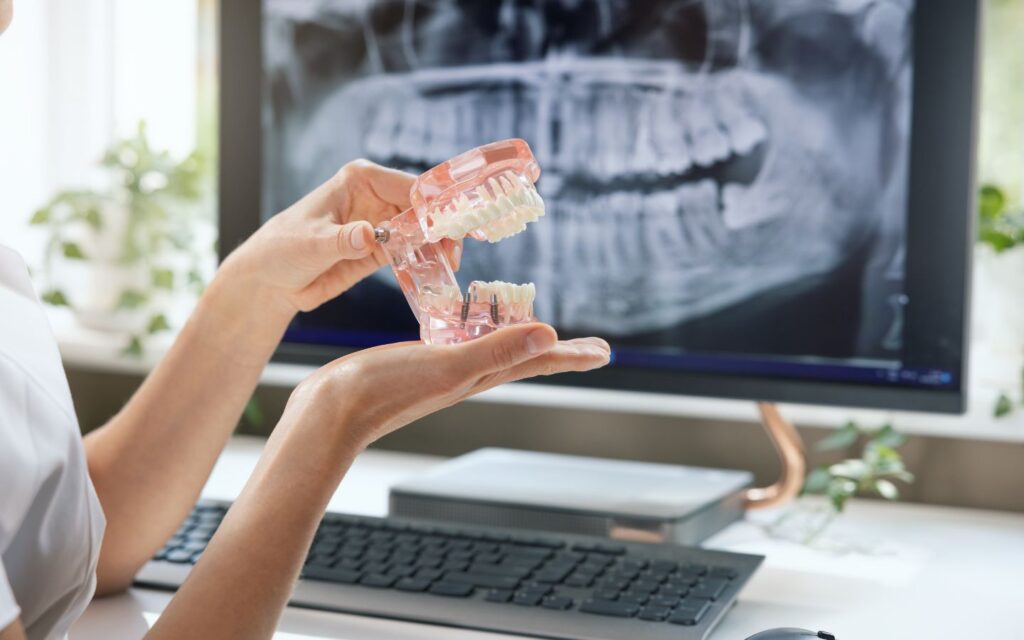
In cases of total edentulism or non-recoverable teeth, the treatment follows a structured pathway. Its precision determines the quality of the final result.
- Digital planning: The procedure is simulated on computer to define position, inclination, and depth of the implants.
- Procedure and immediate loading: Placement of the four implants and, when possible, application of the temporary fixed prosthesis within 6–48 hours.
- Healing phase: Osseointegration period of approximately 3–6 months, during which the implants integrate with the bone.
- Definitive prosthesis: Replacement of the temporary prosthesis with a definitive structure, more resistant and aesthetically advanced.
The result depends on the quality of planning as much as on execution.
Why choose Resta in Italia for your All-on-4
When it comes to All-on-4 implants, the treatment doesn’t end with the procedure. It’s a journey.
Dental tourism may seem convenient, but it moves the most delicate phase abroad: monitoring over time.
Choosing Resta in Italia means:
- real continuity: the same team follows you over time
- rapid interventions: immediate assistance when needed
- certified materials: guaranteed traceability and quality
- scheduled maintenance: essential for the longevity of implants
Here you’re not just purchasing a procedure, but a result that must last for years.
Want to know more about costs and timelines for All-on-4 implants?