

In modern implantology, the final result is built even before the surgery. Diagnostic technologies and advanced digital tools now allow every detail to be analyzed with precision and treatment to be planned with extreme accuracy.
This shift has profoundly changed the approach to treatment: today, work is increasingly structured, with the goal of reducing variables and achieving stable results over time. For the patient, this translates into more controlled procedures, clearer pathways, and more informed management of every phase.
Modern implantology: what it is and how it differs from traditional techniques
Implantology is the branch of dentistry concerned with replacing missing teeth by inserting titanium implants or biocompatible materials into the jawbone, onto which crowns or fixed prostheses are then attached.
In the past, planning relied on more limited tools and the clinician’s clinical experience, with inevitable margins of approximation.
Today, however, the approach has changed: the procedure is increasingly designed in advance, analyzing every aspect with greater care.
This means:
- greater control during surgery
- reduction of unexpected issues
- more predictable results in the medium and long term
Modern implantology, therefore, is not just a technical matter, but a different way of managing the entire care journey.
Advanced diagnostics: the starting point of modern implantology
Every implant treatment starts with an accurate evaluation phase.
Knowing the bone structure, the position of anatomical structures, and the general condition of the mouth is essential for building an effective treatment plan.
In recent years, diagnostic technologies have introduced increasingly precise tools, which allow for a deeper reading of the clinical situation.
These developments represent an important step forward because they allow for reduced uncertainty and improved planning quality.
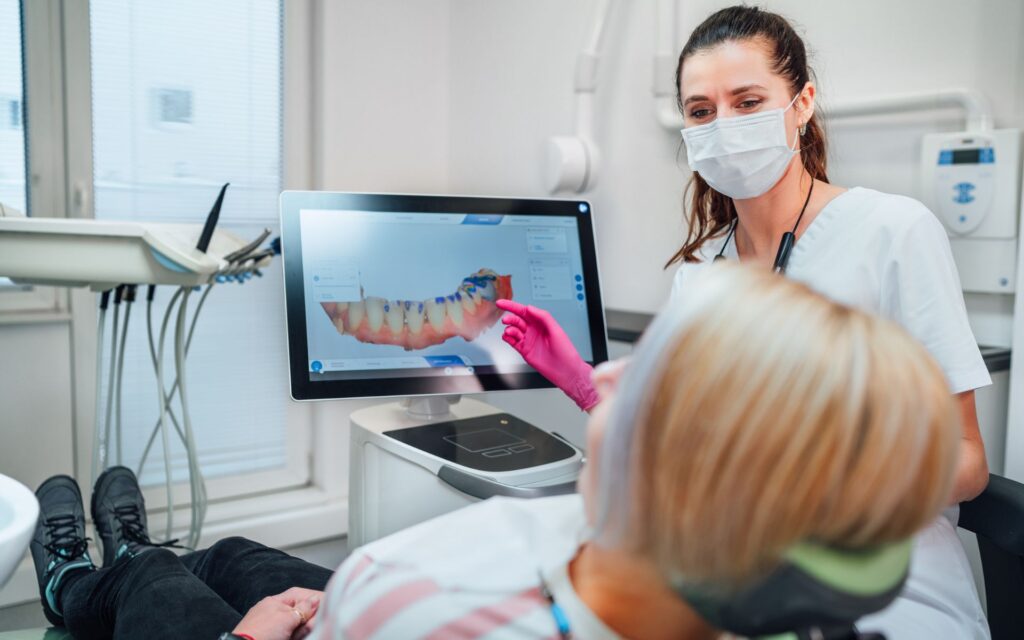
Among these, a central role is played by digital X-rays, which provide detailed images with lower radiation exposure, and the intraoral scanner, which allows for the acquisition of extremely accurate and comfortable digital impressions for the patient.
In practice, a thorough evaluation allows for:
- choosing the most correct position for the implant
- avoiding sensitive areas
- defining any critical issues in advance
- building a pathway consistent with the patient’s characteristics
The benefits of minimally invasive surgery: less trauma, faster recovery
One of the biggest fears when it comes to implants concerns post-operative pain. Here, digital dentistry represents a fundamental breakthrough.
Thanks to precision in planning, the procedure becomes targeted and conservative. Where clinical conditions allow, the use of guided surgery protocols makes it possible to drastically limit the need for extensive incisions or the application of numerous sutures.
This “gentle” approach translates into concrete benefits for the patient:
- less swelling: tissue trauma is reduced to the bare minimum
- accelerated recovery: you can return to your daily activities much faster
- reduced infection risk: tissues heal sooner and more linearly
- maximum comfort: even in the hours immediately following the surgery, discomfort is comparable to that of a common filling
In summary, the reduced invasiveness puts your well-being at the center.
Why technology affects the lifespan of implants
The lifespan of a dental implant depends on the quality of the materials, but also on how a new element “works” together with the others.
We are talking about perfect integration, which is first and foremost a matter of biomechanical balance.
Modern implantology allows for planning the placement of each screw with infinitesimal precision, ensuring optimal distribution of chewing loads. Even a deviation of a few millimeters can generate localized overloads in the long run. These abnormal stresses are among the main causes of bone resorption and peri-implant tissue distress.
Digital design also allows for:
- pre-evaluating bone quality and volume to select the most suitable implant diameter and length for each person’s specific anatomy
- planning the occlusion and predicting exactly how the new tooth will “mesh” with the opposing teeth, thus avoiding traumatic contacts
- simulating both the aesthetic and functional result and monitoring any changes over time to prevent potential complications.
Resta in Italia: your choice for modern implantology without surprises
At Resta in Italia centers, modern implantology is a constantly evolving journey that progressively integrates advanced technologies and increasingly structured protocols, with the goal of offering more precise and predictable treatments.
Attention is focused not only on the final result but on the patient’s entire journey: from the initial evaluation to planning, through to follow-ups over time.
Investing in innovation means constantly improving standards, tools, and methodologies, keeping patient safety and well-being at the center.
Want to find out if you are an ideal candidate for modern implantology?